

Traditional SEO writing focused heavily on keyword placement. Many writers produced long paragraphs filled with repeated phrases. That approach worked when search engines relied mostly on keyword matching.
Modern search systems work differently.
Today, search engines use:
- NLP
- entity recognition
- semantic search
- vector embeddings
- contextual retrieval
- LLM-based understanding
Google AI Overviews, RAG systems, and AI assistants now extract answers from smaller content chunks. These systems prefer direct factual sentences instead of bloated paragraphs.
Atomic sentence writing supports that shift.
What Is an Atomic Sentence in SEO?
An Atomic Sentence contains one standalone fact.
Each sentence communicates one primary idea.
Example:
Bad:
“SEO improves rankings and builds trust while helping businesses generate leads.”
Better:
“SEO improves rankings.
SEO can increase trust.
SEO may improve lead generation.”
This structure improves machine readability.
An Atomic Sentence presents a single idea, fact, or piece of information in one sentence. Each sentence should communicate one clear meaning without unnecessary filler.
Why AI Search Systems Prefer Atomic Sentences
AI crawlers process information differently from older search engines.
Traditional search engines mainly matched keywords. Modern AI systems analyze:
- entities
- relationships
- contextual meaning
- semantic patterns
- retrievable chunks
Atomic sentence structures reduce ambiguity.
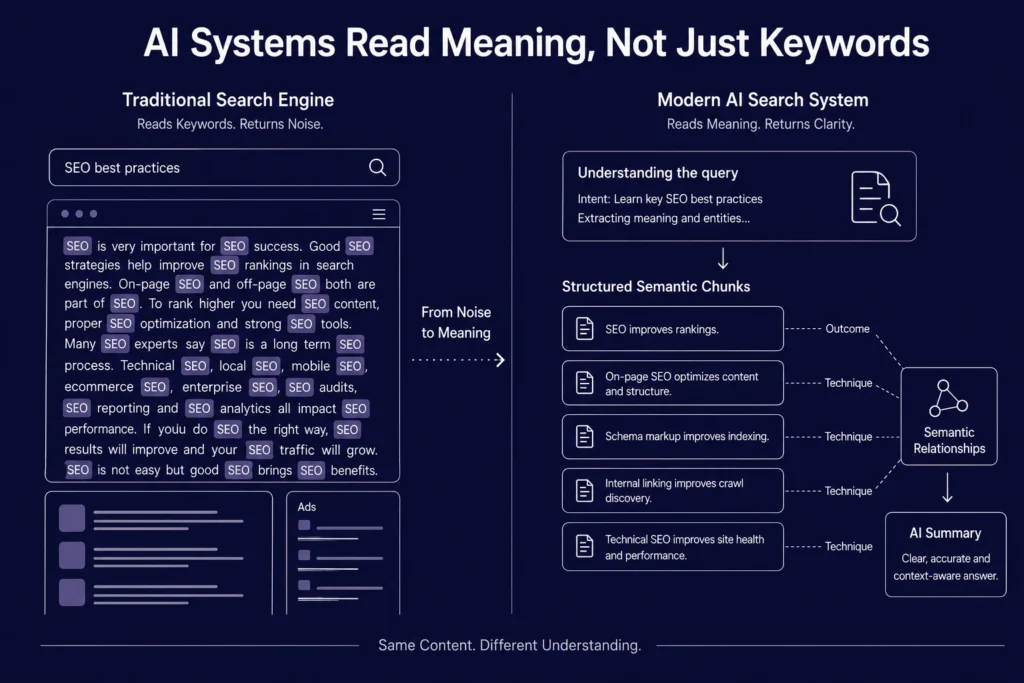
Atomic sentence in SEO also improve extraction quality for:
- AI Overviews
- featured snippets
- voice assistants
- RAG pipelines
- LLM summarization
Human readers also prefer concise content
Modern readers rarely consume entire blog posts line by line.
Most users:
- skim pages
- search for direct answers
- ask AI assistants
- use voice search
Atomic structures match modern reading behavior.
Gemini and ChatGPT both return information in small factual chunks instead of large essays.
How Semantic SEO Connects With Atomic Sentences
Semantic SEO focuses on topic relationships instead of exact keyword repetition.
Modern systems use:
- entity-based SEO
- NLP analysis
- vector search
- contextual retrieval
- semantic matching
Atomic sentence in SEO help semantic SEO because every sentence becomes easier to classify.
Example:
“Google Search Console detects indexing issues.”
This sentence clearly contains:
- Entity: Google Search Console
- Action: detects
- Topic: indexing issues
AI systems can understand the relationship instantly.
Messy paragraphs reduce clarity.
Anatomy of an Atomic Sentence
An atomic sentence usually follows a simple structure:
Component | Meaning | Example |
Subject | Main entity | Clear My Course |
Predicate | Action or relationship | is located in |
Object | Target or value | Kochi |
Example:
“Clear My Course is located in Kochi.”
This sentence works because:
- the entity is clear
- the relationship is clear
- the location is clear
No filler exists inside the sentence.
How Atomic Sentences Improve RAG and Vector Retrieval
RAG stands for Retrieval-Augmented Generation.
RAG systems break content into chunks before retrieval.
Atomic sentence in SEO improves chunk quality because each sentence already contains an independent meaning.
This improves:
- vector embedding quality
- semantic similarity matching
- passage retrieval
- answer extraction
- contextual ranking
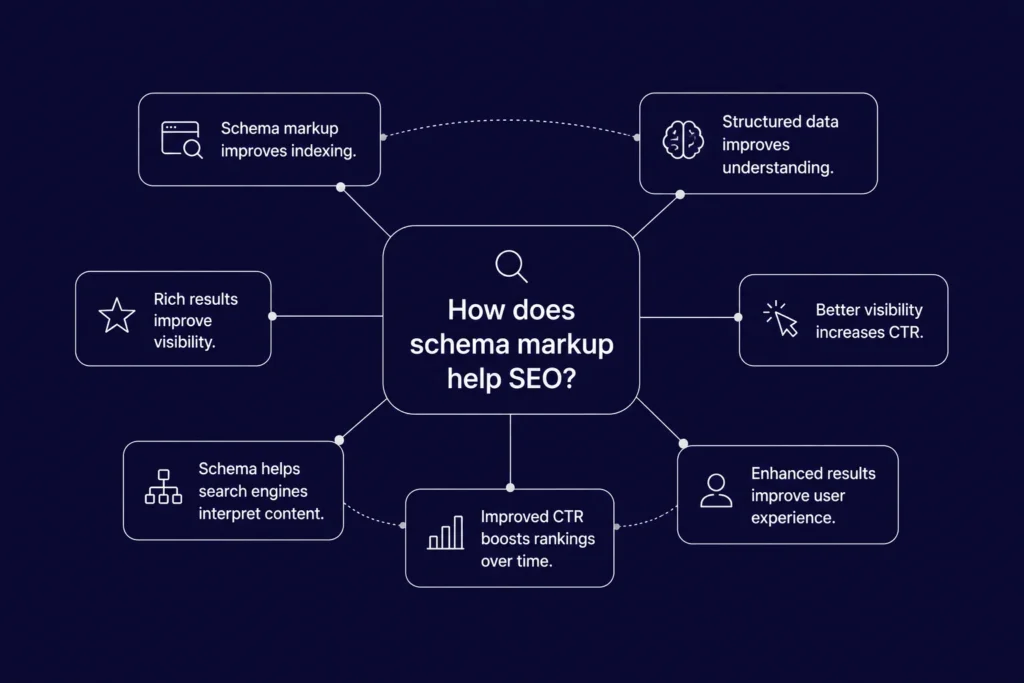
Example of retrieval-friendly writing
Weak:
“This helps rankings.”
Better:
“Internal linking improves Google crawl discovery.”
The second sentence contains:
- subject clarity
- topical context
- retrievable meaning
That’s why atomic sentences matter for AI search systems.
Why Keyword Stuffing is Losing Value
Keyword stuffing creates weak semantic signals.
Modern AI systems analyze:
- contextual depth
- entity relationships
- topic consistency
- factual density
Repeating the same keyword unnaturally may reduce readability.
Instead of repeating:
“SEO course in Kochi”
Use semantic variations naturally:
- digital marketing training in Kerala
- SEO learning program
- search engine optimization course
- AI SEO workshop
This improves topical association.
Active Voice Improves AI Readability
Active voice creates cleaner sentence structures.
Example:
Passive:
“The ClearMyCourse was founded by Jijo Joseph.”
Active:
“Jijo Joseph founded ClearMyCourse.”
Active voice improves:
- sentence clarity
- entity extraction
- semantic parsing
- readability
Active voice improves sentence clarity.
Active voice also helps AI systems understand entities and relationships more accurately.
Common Mistakes When Using Atomic Sentence in SEO
1. Removing all natural flow
Some writers make content sound robotic.
Atomic writing should still sound human.
Bad example:
“SEO is useful.
SEO helps traffic.
SEO helps rankings.”
This feels repetitive.
2. Overusing pronouns
Pronouns create ambiguity.
Weak:
“It improves indexing.”
Better:
“Schema markup improves indexing clarity.”
3. Adding filler adjectives
Avoid vague promotional phrases.
Weak:
“We are one of the best SEO agencies.”
Better:
“The agency provides technical SEO services.”
Prefer video learning? Watch the Atomic Sentence SEO guide below.
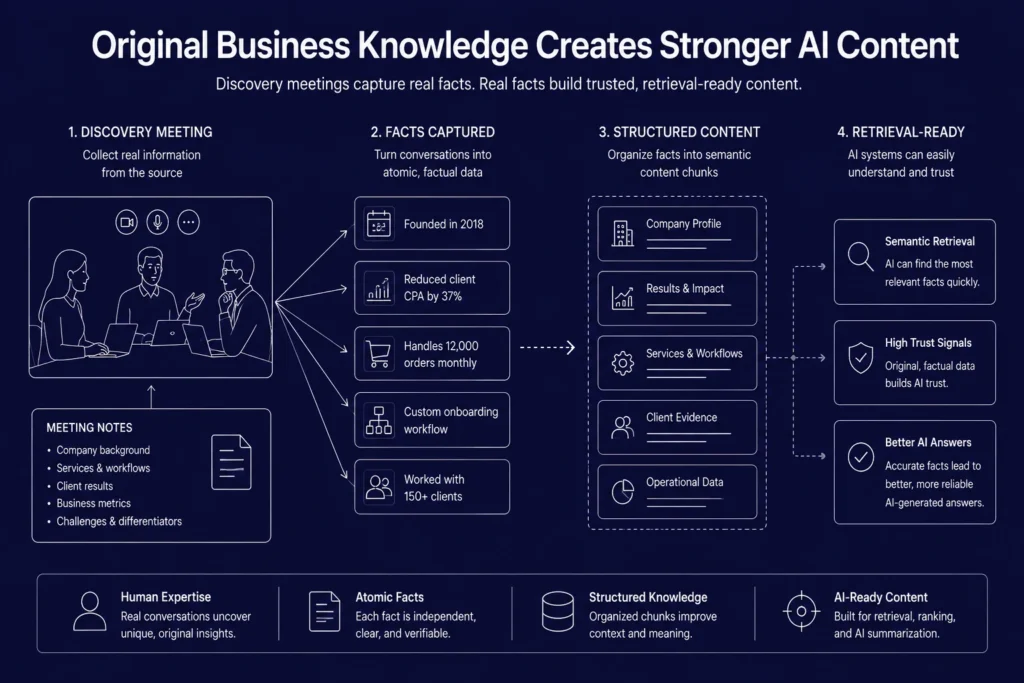
Use Discovery Meetings to Collect Better Atomic Facts
Many websites fail because writers lack real source information.
SEO professionals should conduct detailed discovery meetings before writing content.
Good discovery sessions help gather:
- company history
- founder information
- case studies
- client results
- operational data
- service workflows
- business metrics
These details produce stronger factual content.
AI systems trust original information more than generic copy.
How llms.txt May Support AI Retrieval
Some SEO professionals are testing llms.txt.
The concept resembles robots.txt.
An llms.txt file may provide:
- entity facts
- business summaries
- structured brand information
- crawl-friendly text
Example:
- “Jijo Joseph is an SEO trainer.”
- “Jijo Joseph co-founded ClearMyCourse.”
This may help AI systems retrieve entity information faster.
The concept is still evolving.
Putting It Into Practice
Atomic sentence structures match how modern AI systems process information.
Google Search, AI Overviews, RAG systems, vector databases, and LLM-powered assistants prefer content with:
- factual clarity
- semantic precision
- retrievable chunks
- contextual relationships
SEO writing is shifting from keyword-heavy copy toward structured factual communication.
Writers who adapt early may gain stronger visibility across both traditional search engines and AI-driven retrieval systems.
If you want structured learning of modern SEO, AI SEO, Semantic SEO, and retrieval-focused content strategies, learn from industry experts with Clear My Course.
FAQs
What is an atomic sentence in SEO?
An atomic sentence contains one standalone fact in one sentence. This structure improves AI readability and semantic extraction.
Do atomic sentences improve Google rankings?
Atomic sentence structures may improve retrieval quality, passage indexing, and contextual clarity. Those factors can support modern SEO performance.
How do AI search engines read content?
AI systems use NLP, semantic analysis, entity recognition, and vector retrieval to understand relationships between concepts.
Can atomic sentences help AI Overviews?
Yes. Short factual sentences are easier for AI systems to extract into summaries and answer boxes.
Are atomic sentences useful for RAG systems?
Yes. RAG systems retrieve smaller chunks of content. Atomic structures improve chunk independence and semantic clarity.
Should every sentence be atomic?
No. Natural flow still matters. Atomic sentence structures should dominate informational sections without making the article feel robotic.
Does Google still care about keywords?
Keywords still matter. However, semantic relationships and contextual relevance now carry much stronger weight.
Which tools help semantic SEO analysis?
Useful tools include:
- Google Search Console
- Google Analytics
- Ahrefs
- Semrush
